
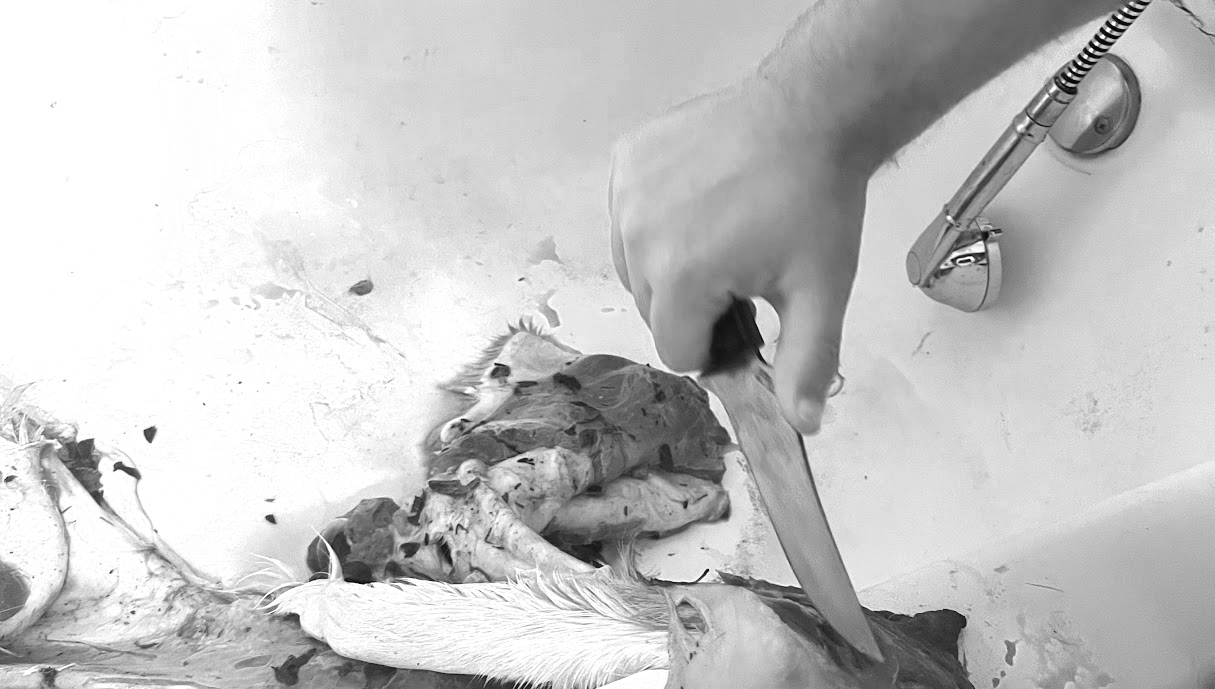
When I’m working with a hide, I pull one edge taut and watch what happens farther in. A fold moves. A section I thought would lie flat lifts off the table. I let up a little and try from another angle. There’s a point where pulling harder stops telling me anything. I have to move my hands.
I grew up on a farm outside Elgin, Texas, in the Blackland Prairie. I’ve written about what it meant to grow up queer there, but I’ve spent less time thinking about what my hands learned there. I still judge how awkward something will be to carry by lifting one end first. I still put a hand on a piece of wood and lean into it a little before I trust it to take my weight. Those are small judgments, the kind I make before I’ve put words to what I’m doing.
There’s a temptation to make a story about inherited skills sound tidy, as though I could name the person who taught me each thing and tell you exactly when it happened. I can do that with some things. With others, I was around the work long enough that I picked up a way of doing it. Years later, I’ll be standing over a table in the studio and recognize something familiar in the way I’m holding a piece of leather. The recognition usually comes after I’ve already done it.
I think about that when I look at Ethel, a sculpture I made with deer hide. So much of my time with a hide happens close up, with my attention on a few inches at a time. I get to know it by where it gives and where it resists. When I step back, I can see the whole form, but I still find myself looking at the places my hands spent the most time. I know a fold by how it felt to work it before I know it by the shadow it casts.
Growing up, I paid attention to what my hands might give away about me. I learned to notice which gestures drew a look and which ones passed without comment. A hand could be read as evidence that I knew what I was doing, or it could give somebody a reason to question what kind of boy I was. It was possible to feel sure of myself doing the work and still think about how I looked doing it.
In the studio, I get to decide how long a gesture lasts. I can spend an afternoon turning the same piece over, working from both sides, seeing how little pressure it takes to make a difference. Some of what I learned growing up helps me do that. There are also habits I’ve had to work my way out of, like the impulse to pull harder just because I can.
I like the moment when I ease up on the hide and see where it settles. Sometimes the fold stays. I’ll run a finger along it and decide to leave it there.